Energy Storage Systems Research Hub

Project Overview

This site explores recent advances in energy storage technologies and their role in enabling resilient, low‑carbon power grids. We summarise four peer‑reviewed papers spanning optimisation frameworks, hybrid storage solutions, integrated storage systems and long‑duration storage. Each paper page includes further detail, interactive content and references.

Integrated optimisation of energy storage and green hydrogen

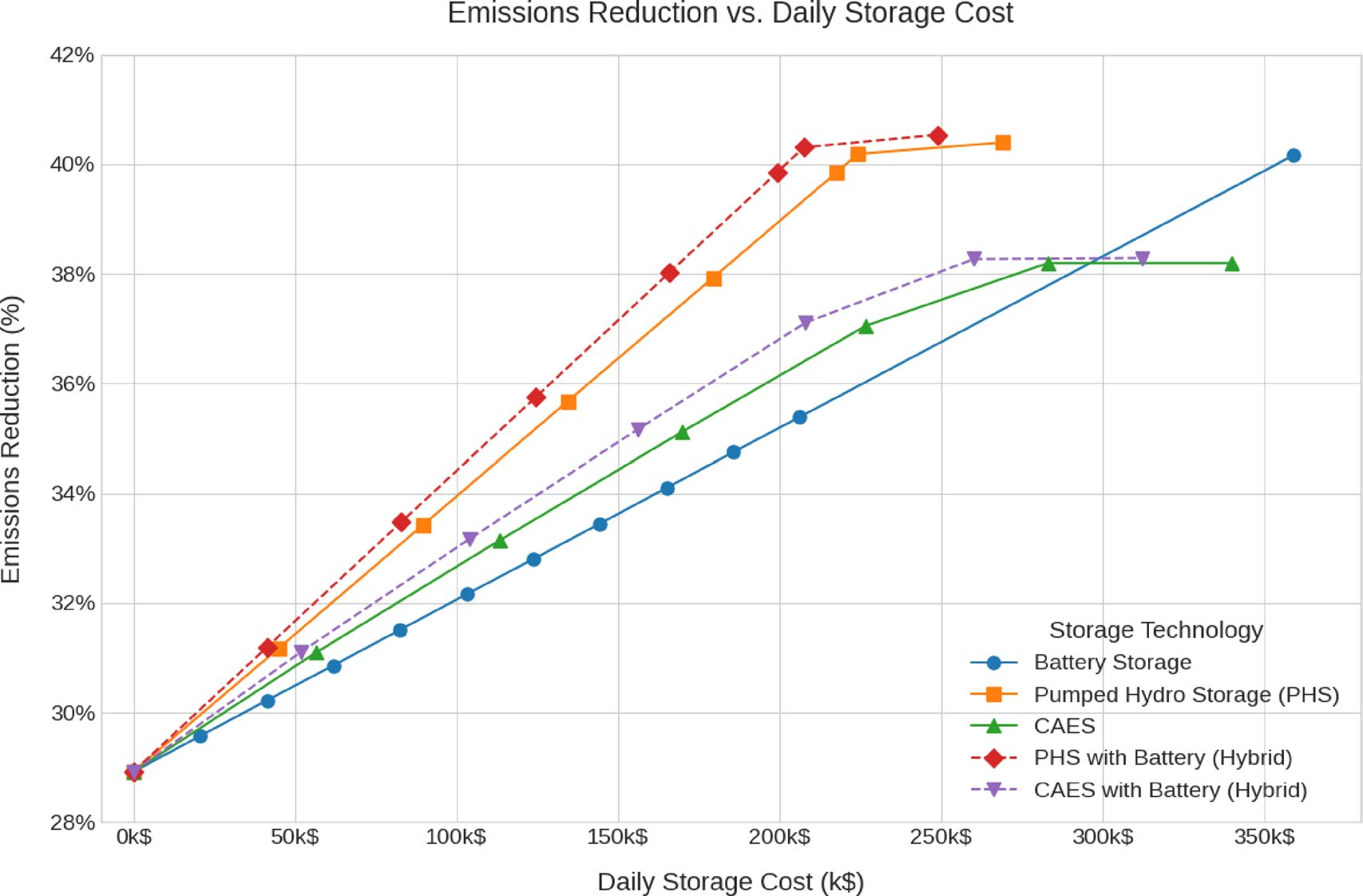
Emissions reduction vs storage cost chart

A multi‑objective optimisation framework evaluates battery, pumped hydro, compressed air and hybrid configurations under realistic system constraints. Without storage, renewable penetration is limited to about 28.6% and daily emissions reach 1538t CO2. A pumped‑hydro‑plus‑battery configuration enables 40% renewable penetration and reduces emissions by roughly 40%, while lowering system costs [1]. Scalability is demonstrated on larger test systems, and future work points to stochastic modelling and sector coupling [1].
Advancements in hybrid energy storage systems

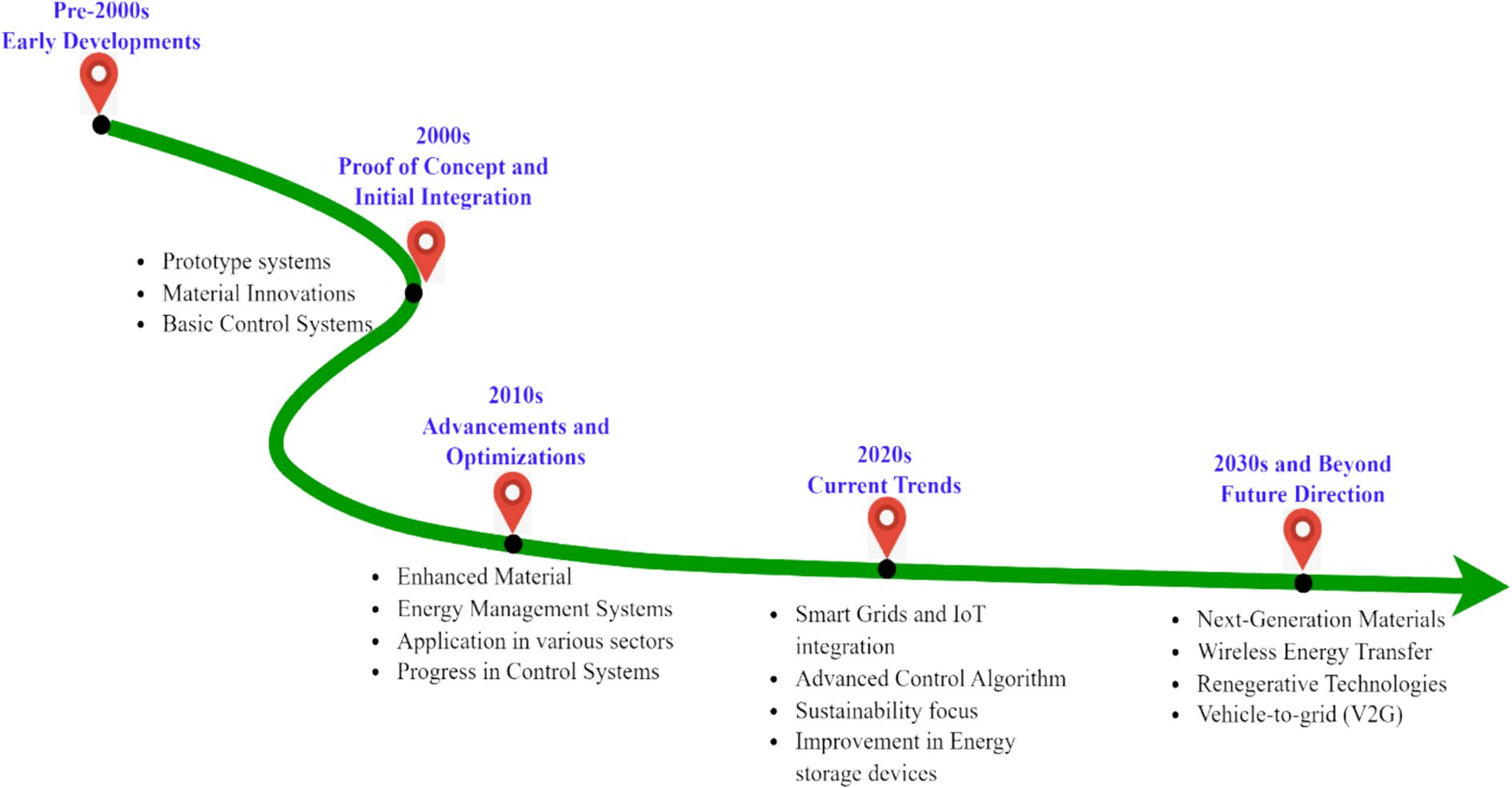
Hybrid energy storage systems timeline

Hybrid energy storage systems (HESS) combine complementary devices such as batteries, supercapacitors and hydrogen systems to mitigate the variability of renewable energy. A review of recent work discusses components, design considerations, control strategies and applications. Case studies highlight how HESS improve grid stability and reliability. Key challenges include intelligent control, sustainable materials and efficient recycling processes for widespread adoption [2].

Integrated energy storage systems for grid efficiency

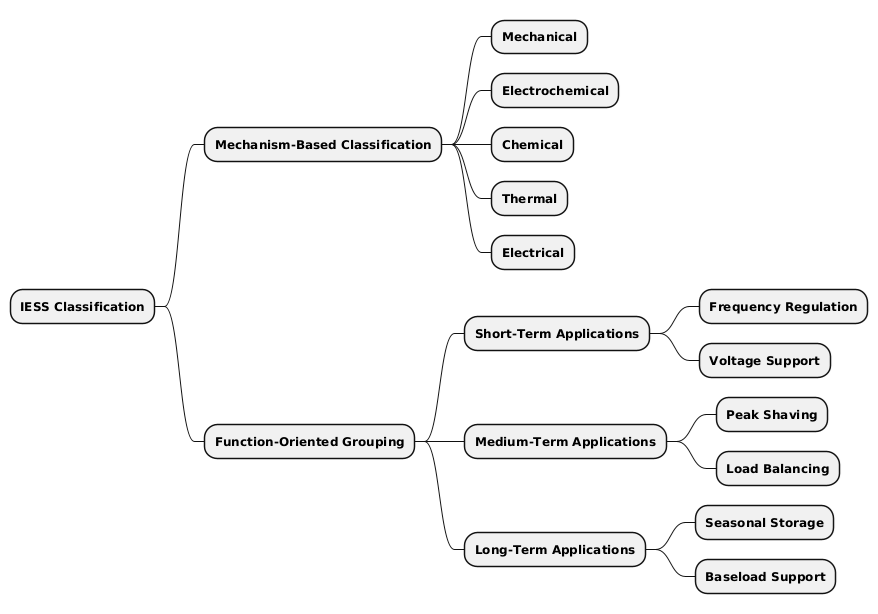
IESS classification diagram

A multi‑criteria decision analysis (MCDA) framework synthesises techno‑economic optimisation, lifecycle emissions and policy factors to guide the deployment of integrated energy storage systems (IESS). Hybrid configurations such as battery–supercapacitor improve grid stability by around 15% in high‑renewable scenarios, while regional policies can reduce deployment timelines by 30–40% and cut energy poverty by one‑quarter [3]. The framework also emphasises circular‑economy mandates like 70% lithium recovery to reduce raw material costs [3].

The value of long‑duration energy storage

Long‑duration storage key findings chart

Modelling a zero‑emissions Western Interconnect under 39 scenarios shows that long‑duration energy storage (LDES) is particularly valuable in wind‑dominated regions and regions with declining hydropower. Seasonal operation becomes cost‑effective when capital costs fall below around 5 US$/kWh, and mandating enough LDES to enable year‑long cycles can reduce peak electricity prices by more than 70%[4].

At‑a‑Glance Comparison

Paper Focus Key Findings
Integrated optimisation Multi‑objective optimisation of storage and green hydrogen Pumped‑hydro–battery yields 40% renewable penetration and 40.5% emission reduction; battery alone produces more hydrogen but is costly [1].
Hybrid systems review Combining multiple storage devices HESS improve grid reliability and require advanced control, sustainable materials and recycling strategies [2].
IESS grid efficiency MCDA framework for integrated storage Battery–supercapacitor increases grid stability by 15%; tailored policies cut deployment times and energy poverty; circular‑economy mandates reduce costs [3].
LDES value Long‑duration storage in zero‑emission grids LDES particularly valuable in wind regions; cost‑effective below 5 US$/kWh; mandates lower peak prices by >70[4].

Project Video

placeholder for the project summary video

Feedback Form

We value your feedback. Please let us know your thoughts.

Reason for comment
Contact information

References

  1. A.M. Asim, A.S.A.Awad, M. A. Attia, A. I. Bhuiya and colleagues, “Integrated optimisation of energy storage and green hydrogen systems,” Scientific Reports (2023).
  2. A.M. Adeyinka, O.C. Esan, A. O. Ijaola and P. K. Farayibi, “Hybrid energy storage systems: a review,” Sustainable Energy Research (2023).
  3. R.I. Areola, A. A. Adebiyi and K. Moloi, “Integrated energy storage systems for enhanced grid efficiency: a multi‑criteria decision analysis,” Energies (2023).
  4. M. Staadecker, J. Szinai, P. A. Sanchez‑Perez, S. Kurtz and P. Hidalgo‑Gonzalez, “The value of long‑duration energy storage for a fully renewable grid,” Nature Communications (2023).